
Project MidSpan

A living, source-based review of the proposed data-center campus in the Hiwassee River Industrial Park and the legal dispute over Bradley County's data-center rules.

Public Transparency. Government Accountability. Responsive Representation.

Current Snapshot

Project MidSpan is a proposed large-scale data-center campus on approximately 306 acres in Bradley County's Hiwassee River Industrial Park. The property is controlled by SDCL Tennessee Propco LLC. The project is now intertwined with an active Chancery Court challenge to data-center zoning rules adopted by the Bradley County Commission in April 2026.

Case file updated October 7, 2026. Legal allegations are identified as allegations unless supported independently or resolved by the court. No county responsive pleading or court order resolving the lawsuit is in the reviewed source set as of this update.

Site
Approximately 306 acres
Developer / Owner
SDCL
Power Context
≥300 MW claimed available
County Rule
I-2 + 3,000-ft separations
High School Distance
~1,700 ft reported
Current Process
Active litigation
New here?

Questions people ask first

Plain-language answers to the questions newcomers most often have about Project MidSpan. Each answer links to the deeper evidence review.

Why is SDCL suing Bradley County?

Bradley County adopted new data-center rules on April 20, 2026 that restrict data centers to I-2 Special Impact Industrial zoning and add 3,000-foot separation requirements. SDCL says the rules were adopted through a legally defective process and effectively prevent its proposed MidSpan project; the county disputes the challenge and the court has not resolved the merits.

Who is the company behind MidSpan?

The property owner and plaintiff is SDCL Tennessee Propco LLC, a Delaware limited liability company. It is associated with Sustainable Development Capital, a London-headquartered investment firm that describes itself as focused on energy-efficiency and infrastructure investment.

What changed after the company bought the property?

SDCL says it acquired the site after due diligence and after receiving a county planning letter that it interprets as supporting large-scale data-center use in I-1 zoning. The county later adopted the April 2026 rules moving data centers to I-2 and adding the 3,000-foot separation requirements. Whether the earlier communications create legal rights is disputed in the lawsuit.

Why does Walker Valley High School matter?

Public reporting and county discussion place the nearest proposed MidSpan building at roughly 1,700 feet from Walker Valley High School, while the county’s April rule requires 3,000-foot separation from schools. Bradley County Schools also owns adjacent property planned for a future middle school, making setbacks, traffic, noise, screening, and emergency planning important site-specific questions.

Has the MidSpan data center been approved?

The reviewed record still describes MidSpan as a proposed campus. The lawsuit challenges the county zoning rules, but filing or winning a zoning case would not by itself substitute for every project-specific permit, utility approval, site-plan review, and other requirement that may apply.

Why are taxpayers talking about the cost of the lawsuit?

County leadership reported that insurance coverage for the SDCL lawsuit defense was denied. The reviewed public record still does not include the denial letter, applicable coverage language, counsel fee agreement, defense invoices, or the county fund paying those costs, so the possible taxpayer exposure is a real but not yet quantified question.

Latest Developments

Recent changes to the public record, with direct links to the detailed reviews they affect.

All updates →
ReportedOct 5, 2026
County litigation / insurance update

County says insurance coverage was denied for MidSpan lawsuit defense

Local 3 reporting from the October 5 Bradley County Commission meeting quotes County Mayor D. Gary Davis saying the county insurer denied its claim related to defending the SDCL lawsuit. Davis said he had asked the attorney to move forward with the defense and was asking the Commission to do the same. The county’s official meeting index still did not provide October 5 minutes or a linked video recording when Placeward checked on October 7.

MID-001MID-023

DocumentedSep 28, 2026
Government meeting record

Public comment on data centers continues at County Commission work session

Bradley County’s official September 28 work-session minutes record seven speakers opposing data centers or related facilities. Two requested moratoria, and one speaker specifically asked the Commission to fight Project MidSpan and Project River. The Commission took no MidSpan-specific action at that meeting.

MID-022

ReportedSep 24, 2026
School-system update

Bradley County Schools says future middle-school plan remains active

Local reporting says Bradley County Schools still plans to move forward with a proposed middle school near Walker Valley High School despite the Project MidSpan dispute. The Board of Education had approved purchase of adjacent Lauderdale Memorial Highway property for a future middle school in 2024.

MID-017MID-018

Community Record

Public commentary is useful evidence of what people are concerned about, support, oppose, or want decision-makers to address. It is not automatically evidence that the underlying factual claim is true.

Concern / opposition

Opposition to data-center development

Bradley County’s September 28 work-session minutes record seven public speakers opposing data-center development or related facilities. The comments document public concern; they are not findings about Project MidSpan’s actual impacts.

Sources:MID-022
Concern / opposition

Request for a development moratorium

Two speakers at the September 28 work session requested a moratorium on data-center development, documenting a public request to pause or slow decisions while impacts and rules are evaluated.

Sources:MID-022

No support or potential-benefit commentary is currently documented in this community record.

Priority Evidence Still Needed

The reviewed public record does not yet establish a final campus load, buildout schedule, tenant or operator, investment total, permanent-job count, cooling design, water demand, generator inventory, traffic-impact study, final permit matrix, tax arrangement, or binding community-benefit package. The records below would resolve many of those highest-value questions.

County response to the lawsuit
Answer, motions, affidavits, exhibits, and any court orders that test or rebut SDCL's allegations.
Original county communications
The 2022 planning letter and all related zoning, Chamber, planning-office, and economic-development correspondence provided before the land purchase.
Complete April zoning record
Planning Commission materials, March public notice, April 13 work-session packet, April 20 agenda packet, substitute text, video, and adopted-resolution record.
Current site plan
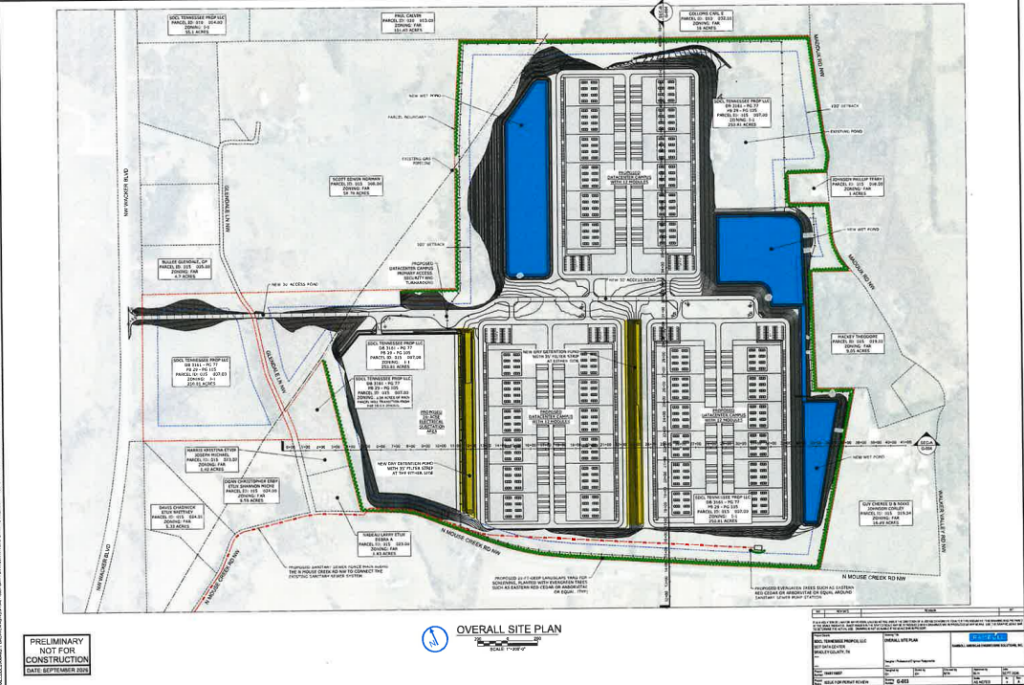
Building footprints, setbacks, substations, generator yards, cooling equipment, roads, screening, stormwater facilities, and distances to the school and neighboring properties.
Power documentation
Utility studies, service agreements, interconnection plans, capacity commitments, upgrade costs, and responsibility for those costs.
Water and wastewater basis
Cooling design, water source, peak and average demand, drought assumptions, wastewater volumes, and service-provider capacity.
Noise / air / emergency studies
Generator specifications, acoustic modeling, emissions estimates, testing schedules, fire protection, hazardous-material plans, and emergency-response coordination.
Economic and fiscal terms
Capital investment, jobs, taxes, incentives, PILOT or bond structures, infrastructure obligations, and independent fiscal analysis.
Operator / tenant commitments
Any signed end-user agreement, lease, development agreement, or other document identifying who will operate the campus and under what conditions.
Traffic and construction basis
Project-specific traffic-impact study, school-hour analysis, construction haul routes, access design, road improvements, and responsibility for those costs.
Permit and compliance matrix
Every anticipated state, local, utility, and other approval; filing status; permit holder; enforceable limits; monitoring; public-comment opportunities; and enforcement responsibility.

Evidence Rules

A pleading is evidence of a claim, not proof that the claim is correct.

Government action is documented separately from its legal validity. The Commission's vote and the court challenge are both part of the record.

Developer commitments remain attributed until independently documented or made enforceable.

Community concerns remain visible. They are labeled as concerns until supported by independent evidence.

New information can change the file. The case file should preserve earlier claims and designs while incorporating later records, court filings, engineering information, and permit developments.